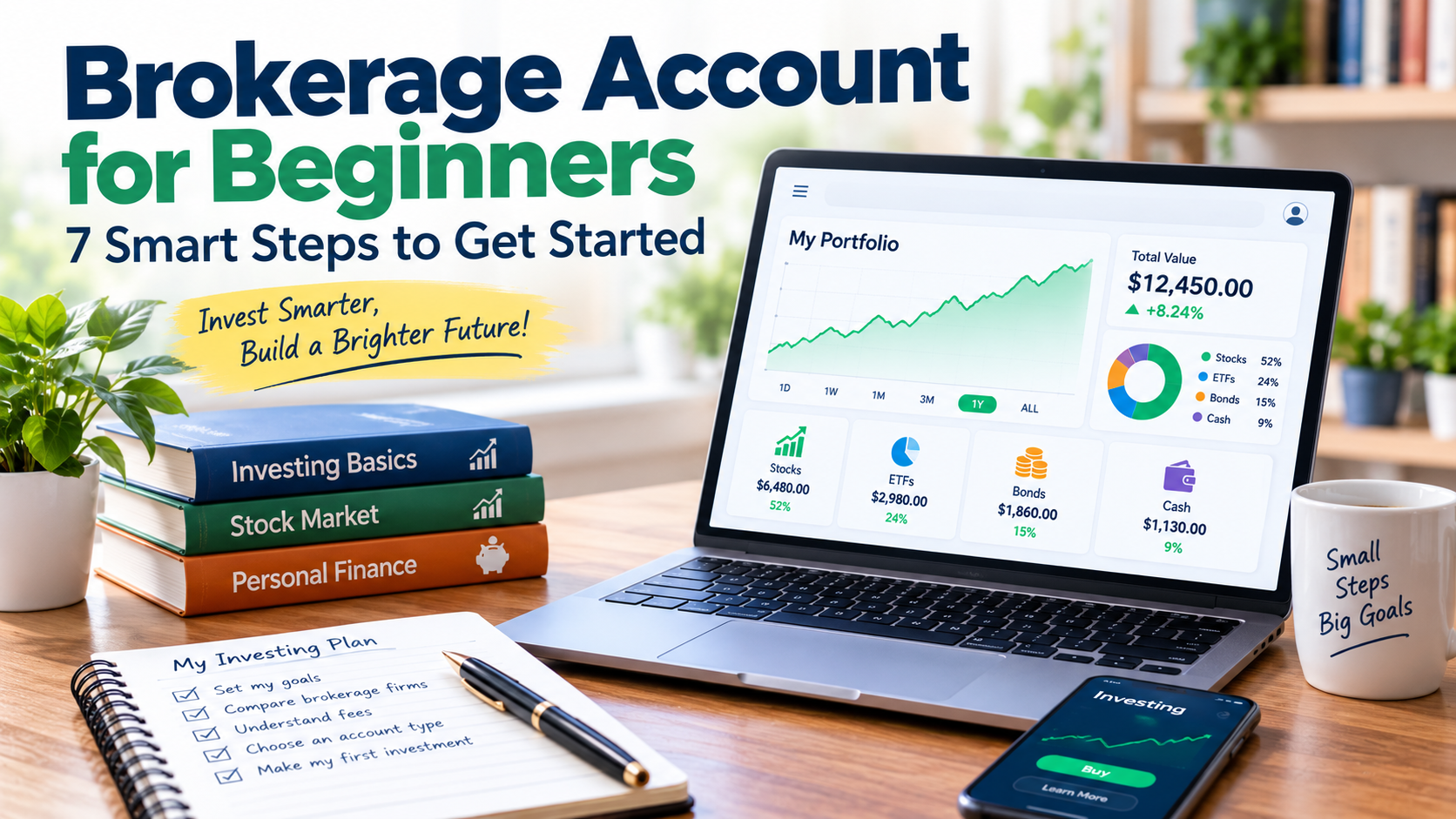
Brokerage Account for Beginners: 7 Smart Steps to Get Started
Opening your first investment account can feel complicated when you’re unfamiliar with stocks, exchange-traded funds (ETFs), trading fees, and investment risk. The good news is that you don’t need to be an experienced investor or have thousands of dollars to begin learning how investing works.
A brokerage account for beginners provides a way to buy and sell investments through a brokerage firm. Depending on the provider and account features, you may be able to invest in stocks, bonds, mutual funds, and ETFs. Your account can also help you track your holdings and monitor how your investments change in value.
However, choosing an account involves more than downloading an investing app. You should understand the available account types, compare fees, check the broker’s background, and decide how much risk you can reasonably accept.
This guide explains how brokerage accounts work, what to look for when comparing providers, and how to take your first steps toward investing.
What Is a Brokerage Account?
A brokerage account is an investment account offered by a brokerage firm that allows you to buy, hold, and sell eligible securities.
Unlike a regular savings account, which is generally designed to hold cash, a brokerage account gives you access to investments that may increase or decrease in value.
Depending on the firm, available investments may include:
- Stocks: Shares representing ownership in individual companies.
- Exchange-traded funds (ETFs): Investment funds that trade on stock exchanges and may hold many securities.
- Mutual funds: Pooled investments that follow a particular strategy or investment objective.
- Bonds: Debt securities issued by governments, corporations, and other organizations.
A brokerage account is not itself an investment. Opening one does not automatically mean your money is invested in stocks or funds. You generally need to select investments and place orders, unless you choose a service that manages investments for you.
For an official explanation, see the SEC’s Brokerage Accounts guide.
7 Smart Steps to Choose a Brokerage Account for Beginners
1. Decide What You Want to Achieve
Before comparing brokerage firms, think about why you want to invest.
Your goal can influence which account features and investments make sense for you.
For example:
- Long-term wealth building: You may want access to diversified funds and automatic investing features.
- Learning about the stock market: Educational materials, practice tools, and understandable account statements may be useful.
- Investing for a major future expense: Your time horizon matters because investments can lose value when you need to sell them.
- Generating investment income: You may want to learn about dividends, bond interest, and the risks associated with income-focused investments.
Consider when you expect to need the money. Investments in stocks and stock funds can fluctuate significantly, making them unsuitable for money you cannot afford to lose or may need immediately.
Before investing, consider maintaining accessible emergency savings and addressing expensive debt. Your financial priorities will depend on your income, obligations, and circumstances.
For a broader foundation, read CapsMentor’s guide to personal finance and managing money.
2. Compare Brokerage Firms Carefully
The best brokerage account for beginners is not necessarily the one with the most features or the most attractive advertising. Look for a provider that fits your needs, budget, experience, and preferred way of managing money.
Compare these features before opening an account:
| Feature | What to check |
|---|---|
| Account minimum | Is an opening deposit or minimum balance required? |
| Trading costs | Are commissions or other transaction charges applicable? |
| Investment choices | Does the firm offer the stocks, ETFs, bonds, or funds you want? |
| Fractional shares | Can you invest a specific dollar amount instead of buying a whole share? |
| Automatic investing | Can you schedule recurring deposits or eligible investment purchases? |
| Customer support | Can you reach support when you need help? |
| Educational resources | Are beginner guides, explanations, and research tools available? |
| Account security | Are strong authentication and account alerts available? |
| Cash management | How is uninvested cash held, and what protection applies? |
Some firms advertise commission-free online stock and ETF trades. That does not necessarily mean every service or investment is free. Account transfers, certain mutual fund transactions, optional services, and other activities may involve charges.
Check the firm’s current fee schedule and account agreement instead of relying solely on its marketing.
You should also review its relationship summary, known as Form CRS, and investigate the firm’s registration and background through Investor.gov.
3. Understand Cash Accounts vs. Margin Accounts
One of the most important decisions when opening a brokerage account is choosing between a cash account and a margin account.
Cash account
With a cash account, you pay the full amount required for your investments. You do not borrow money from the broker to purchase securities.
For many beginners, a cash account is a straightforward way to learn how investing works without taking on a margin loan.
Margin account
A margin account allows you to borrow money from your brokerage firm to purchase eligible investments. Your securities may serve as collateral for the loan, and the broker charges interest.
Borrowing can magnify both gains and losses. You may also face a margin call or have securities sold to cover a shortfall under the terms of your agreement.
| Feature | Cash account | Margin account |
|---|---|---|
| Borrowing from broker | No | Yes, subject to approval and terms |
| Interest on borrowed funds | Not applicable | May apply |
| Potential losses beyond the cash invested | Not from ordinary fully paid purchases alone | Possible |
| Complexity for beginners | Generally simpler | More complex and riskier |
Beginner tip: If you do not understand borrowing, margin requirements, and forced sales, avoid enabling margin trading. Confirm the account type before submitting your application because some applications may present margin as a default or optional setting.
The SEC explains these differences in its guide to brokerage account types.
4. Check the Fees Before You Deposit Money
Fees can reduce your investment returns over time, even when individual charges appear small.
When comparing brokerage accounts, review the following:
- Trading commissions: Charges for buying or selling certain investments.
- Account maintenance fees: Recurring charges that may apply to particular accounts.
- Fund expenses: Ongoing expenses charged within many mutual funds and ETFs.
- Transfer fees: Charges for moving assets to another brokerage.
- Wire and withdrawal fees: Costs associated with certain money movements.
- Margin interest: Interest charged when you borrow to invest.
- Optional service fees: Charges for premium tools, advice, or other services.
Not every brokerage firm charges all these fees. The amounts and conditions vary by provider and investment.
For example, imagine two hypothetical ETFs with similar investment objectives. One has an annual expense ratio of 0.10%, while another has an expense ratio of 0.50%.
On a $1,000 investment, those rates correspond to approximately $1 and $5 per year, respectively, assuming the balance remains $1,000. Actual costs will vary as the investment value changes, and other charges may apply.
The lesson is to compare the total cost of investing rather than looking only at the advertised trading commission.
The SEC provides additional guidance in its Investor Bulletin on investment fees and expenses.
5. Learn How Much Money You Need to Start
There is no single minimum amount required to begin investing through every brokerage firm.
Some providers permit account opening without a minimum deposit. Others require a certain balance or impose minimum purchase amounts for particular investments.
Your starting amount should depend on your financial position rather than an arbitrary target.
Consider these steps:
- Cover essential expenses and required debt payments.
- Maintain an appropriate amount of accessible emergency savings.
- Decide how much money you can invest without needing it for near-term expenses.
- Check the account minimum and minimum purchase requirements.
- Review transaction costs and fund expenses before making your first investment.
Can you start investing with $100?
Possibly. If a brokerage offers an account with no opening minimum and supports fractional shares or low-minimum investments, $100 may be enough to get started.
Fractional shares allow you to purchase less than one whole share of an eligible security. For example, if a stock costs $500 per share, a $50 purchase could represent 0.10 of a share if the brokerage supports that transaction and no other restrictions apply.
Fractional-share availability, order execution, transferability, and trading restrictions differ among firms. Read the provider’s terms before purchasing.
Starting small can help you learn the process, but it does not eliminate investment risk or guarantee a profit.
6. Open the Account and Complete Verification
Once you have chosen a brokerage firm, the application process is often completed online.
For US brokerage accounts, you will generally be asked for personal information to verify your identity and comply with applicable legal requirements.
Depending on your circumstances and the firm’s process, you may need:
- Your legal name and date of birth.
- Your residential address and contact details.
- Your Social Security number or other eligible taxpayer identification information.
- Government-issued identification.
- Employment and financial information.
- Details about your investing experience, objectives, and risk tolerance.
Requirements vary by provider and customer circumstances. Some applicants may need additional documentation.
After completing the application:
- Review the account agreement and disclosures.
- Select the appropriate account type.
- Complete any identity verification requests.
- Link an eligible bank account or choose another supported funding method.
- Transfer an amount you can afford to invest.
- Confirm that the funds are available before placing an order.
Do not send money to a firm simply because someone on social media recommends it. Verify the firm’s identity and registration independently, and use its legitimate website or official application.
For a detailed overview of the process, consult the SEC’s guide to opening a brokerage account.
7. Make Your First Investment Thoughtfully
After funding your account, you will need to decide what to buy. You do not have to purchase a stock immediately just because the account is open.
Start by learning the difference between individual stocks and diversified funds.
An individual stock represents an investment in one company. Its performance depends partly on that company’s financial results, competitive position, management, and market conditions.
A diversified ETF may hold shares in many companies or securities, helping spread exposure across multiple investments. However, not every ETF is diversified, and diversification cannot eliminate market losses.
Before buying an investment, ask yourself:
- What does this investment own?
- What could cause its value to decline?
- How much does it cost to buy and hold?
- Does it fit my goals and time horizon?
- Am I investing based on research rather than excitement or social media hype?
You can also learn how dividend-paying investments work through CapsMentor’s guide to dividend investing.
Avoid feeling pressured to trade frequently. A beginner can learn a great deal by understanding investment basics, reviewing fees, and following a consistent plan instead of reacting to every market movement.
Brokerage Account vs. IRA: Which One Should Beginners Consider?
A regular taxable brokerage account and an individual retirement account (IRA) serve different purposes.
A taxable brokerage account generally offers flexibility for investing toward goals that are not limited to retirement. Investment income and realized gains may have tax consequences.
An IRA is designed for retirement saving and has specific tax rules, contribution limits, eligibility requirements, and withdrawal conditions. Traditional and Roth IRAs also differ in their tax treatment.
| Consideration | Taxable brokerage account | IRA |
|---|---|---|
| Main purpose | Flexible investing for different goals | Retirement saving |
| Tax treatment | Taxable events may apply | Depends on IRA type and applicable rules |
| Contributions | No IRA-style annual contribution limit | Annual contribution limits apply |
| Withdrawals | Generally flexible, subject to settlement and account terms | Special tax and withdrawal rules apply |
| Eligibility | Subject to the broker’s requirements | Subject to applicable IRA eligibility rules |
Neither account is automatically the right choice for everyone. Your intended use of the money, access needs, tax situation, and eligibility should guide the decision.
For retirement goals, compare the benefits of an IRA with those of a regular brokerage account before choosing.
Is a Brokerage Account Safe?
A brokerage account can be opened with a regulated firm, but investing always involves risks. It is important to distinguish between protections against brokerage failure and protection against investment losses.
The Securities Investor Protection Corporation (SIPC) may protect eligible customer cash and securities when a member brokerage firm fails and customer property is missing. The standard protection limit is up to $500,000 per separate customer capacity, including a $250,000 limit for cash claims, subject to SIPC rules.
However, SIPC does not protect you against losses caused by declining stock prices, poor investment choices, or ordinary market fluctuations.
Also, protection depends on how your assets are held and the legal entity involved. Cash swept into a bank deposit account may instead fall under applicable FDIC deposit-insurance rules, subject to eligibility and limits.
Before opening an account, check the firm’s SIPC membership and understand how it handles uninvested cash. Read the SEC’s explanation of SIPC protection for more details.
Common Brokerage Account Mistakes Beginners Should Avoid
A little preparation can help you avoid common and costly mistakes.
Investing emergency money. Money needed for rent, bills, or unexpected expenses should not automatically be placed in volatile investments.
Choosing a broker based only on advertisements. Compare fees, available investments, customer service, account terms, and registration.
Ignoring fund expenses. A fund’s ongoing costs can reduce returns over time.
Using margin without understanding it. Borrowing to invest can magnify losses and create additional financial obligations.
Buying investments you do not understand. Learn what a stock, ETF, mutual fund, or other security holds before purchasing it.
Expecting guaranteed returns. No legitimate brokerage account can guarantee that stock-market investments will make money.
Checking prices constantly. Frequent price changes can encourage impulsive decisions. Choose a monitoring routine that fits your strategy and goals.
Forgetting about taxes. Selling investments, receiving dividends, and earning interest may create tax obligations. Consult IRS guidance or a qualified tax professional when necessary.
Frequently Asked Questions
1. What is the best brokerage account for beginners?
The right account depends on your goals, investment choices, budget, preferred support options, and comfort with risk. Compare account minimums, fees, educational tools, security features, and available investments before choosing a provider.
2. Can I open a brokerage account with no money?
Some brokerage firms allow you to open an account without an initial deposit. However, you may need to fund it before purchasing investments, and individual securities or funds may have minimum purchase requirements.
3. How much money should a beginner invest?
There is no universal amount. Start with money you can afford to leave invested and potentially lose, after considering essential expenses, emergency savings, debt, and near-term financial needs.
4. Is a brokerage account the same as a bank account?
No. A bank account is generally used for deposits, payments, and savings. A brokerage account is designed to hold and trade investments. Investment holdings can lose value and do not receive ordinary FDIC deposit insurance merely because they are held in a brokerage account.
5. Do I pay taxes on a brokerage account?
A taxable brokerage account may create tax obligations when you sell investments at a gain or receive taxable dividends or interest. Tax treatment depends on the transaction, asset, holding period, and individual circumstances.
6. Are commission-free brokerage accounts really free?
Not necessarily. A firm may charge no commission on certain online trades while still charging other fees. Investments can also have expense ratios, and some services or transactions may incur additional costs.
7. Should beginners choose a cash or margin account?
A cash account is generally simpler because it does not involve borrowing from the broker to purchase investments. Margin accounts introduce interest costs and the possibility of losses exceeding the amount initially invested. Beginners should understand these risks before considering margin.
8. Can non-US citizens open a US brokerage account?
Some brokerage firms accept certain non-US residents, while others restrict account opening by country or residency status. Documentation, tax forms, eligibility, and available services vary. Check the firm’s official requirements before applying; do not assume that every US brokerage accepts international applicants.
Final Thoughts
Opening a brokerage account for beginners does not have to be overwhelming. The most important steps are to identify your goals, compare brokerage firms, understand the fees, choose an appropriate account type, and learn about investments before buying them.
You can begin with a modest amount if your chosen provider permits it, but starting small does not remove the risk of losing money. Focus on understanding what you own, keeping costs in perspective, and making decisions that fit your financial circumstances.
A brokerage account is a tool, not a shortcut to guaranteed wealth. Used thoughtfully, it can provide a practical way to learn about investing and work toward longer-term financial goals.
Disclaimer: This article is for general educational purposes only and does not constitute individualized investment, tax, or legal advice. Investments can lose value. Verify current brokerage terms, fees, eligibility, and applicable tax rules before making financial decisions.